How a File Is Processed
Processing is sequential, not parallel: one unanswered query holds the whole file.
Last Reviewed/Updated: 01 June 2026. This content is for informational purposes and does not constitute legal advice.
Acquiring a new citizenship through a major financial contribution is a powerful idea for global investors. But the path is a minefield. It’s governed by complex laws and exacting procedures. A single misstep in your paperwork—or a failure to meet the tough due diligence standards—can mean losing both your time and substantial, non-refundable government fees. You absolutely must understand the steps, risks, and timelines before you commit a single dollar.
Citizenship file processing by investment isn't a simple purchase. It is a formal legal procedure. A foreign national makes a specified financial contribution to a country's economy, and in direct exchange, receives citizenship and a passport. The process involves preliminary checks, submitting a mountain of financial and personal documents, weathering a rigorous government background check, getting approved in principle, transferring the funds, and finally, being issued a citizenship certificate.
Citizenship by Investment (CBI) refers to programmes where individuals can obtain citizenship and a passport by making a qualifying investment, typically in the form of a non-refundable donation to a government fund or a real estate purchase. This is distinct from residency-by-investment schemes, which grant residence rights first with a potential, often lengthy, path to later naturalisation.
Due Diligence in this context is the comprehensive investigation conducted by government agencies and specialised third-party firms to verify an applicant's identity, background, wealth, and the lawful source of their investment funds. It is a critical, non-negotiable stage of every reputable investment immigration programme.
The EB-5 Program is the primary U.S. residency-by-investment pathway, formally known as the Employment-Based Fifth Preference category. It requires a foreign investor to make a substantial at-risk investment in a U.S. commercial enterprise that creates or preserves at least 10 full-time jobs for U.S. workers, leading to a conditional Green Card and a subsequent path to citizenship.
What Is the Citizenship by Investment Process at a Glance?
At its core, getting citizenship by investment is a multi-stage legal and administrative journey. This is no simple transaction. It’s a formal application for naturalization on special grounds, subject to the host country’s laws and, more and more, the scrutiny of international bodies. To protect the integrity of its citizenship, every country follows a structured sequence.
The main difference from other immigration routes? Its directness. Unlike "Golden Visas" that give you residency first, a CBI programme is built to grant citizenship outright once you meet all requirements. That’s precisely why the due diligence and application stages are so intense.
The Universal Stages of a CBI Application
While details differ between countries, the life of a CBI file follows a predictable path. Each stage is a gate. Fail at one, and the whole process can grind to a halt.
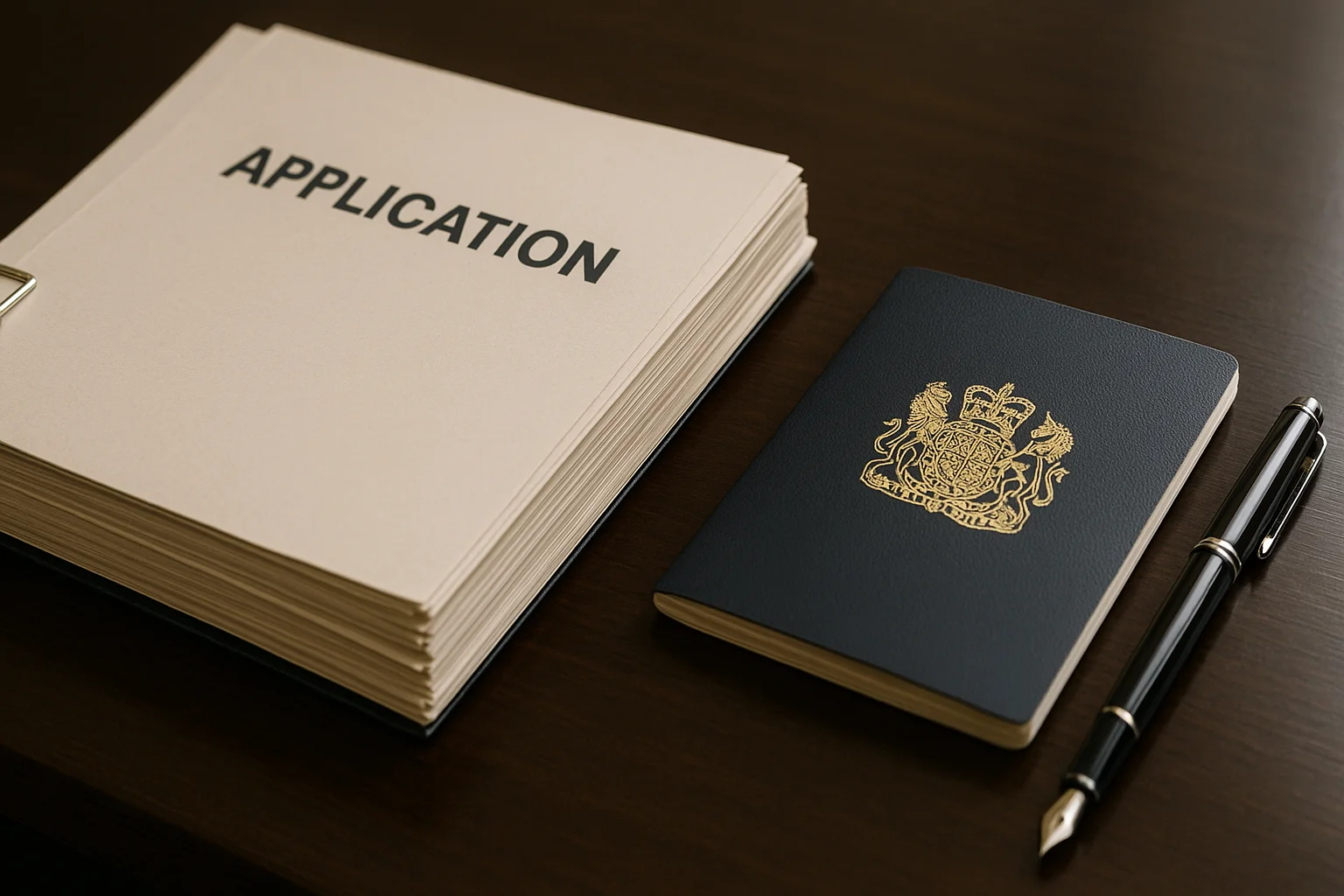
- Initial Consultation and Pre-screening: Everything starts when you hire a mandated agent or lawyer. They'll run a preliminary check to spot any obvious red flags that would guarantee denial. This saves you from losing non-refundable government fees on an application that was doomed from the start.
- Document Collection and Application Submission: For the applicant, this is the hardest part. You’ll gather a huge array of personal documents: birth certificates, marriage certificates, police clearances from every country you’ve lived in, and exhaustive financial records. Everything must be certified, often translated, and apostilled. The final, massive file then goes to the country's citizenship-by-investment unit (CIU).
- Government Due Diligence: Once they have your file, the CIU and other agencies—often with help from international third-party firms—begin a thorough background check. They verify your documents, check your name against global law enforcement databases, and comb through your source of funds. If there are inconsistencies between your application and their findings, you'll face difficult questions and potentially a rejection.
- Approval-in-Principle: If you pass the background checks and your file is perfect, the government issues a formal "approval-in-principle" letter. This is a conditional green light. It’s contingent on you making the full, qualifying investment.
- Investment or Donation Transfer: With the approval letter in hand, you have a strict deadline, often just 30 to 90 days, to make the required investment. This might be a wire transfer to a national development fund or closing the deal on a pre-approved real estate purchase. Missing this window can invalidate your approval.
- Oath and Passport Issuance: After your investment is confirmed, the government issues a citizenship certificate. The last step might involve taking an oath of allegiance—sometimes in the host country, at an embassy, or even virtually. Only after this can you apply for and receive your new passport.
What Is the Legal Framework Governing Investor Citizenship Schemes?
Granting citizenship for cash operates in a tense legal space. It pits national sovereignty against international obligations. While every nation has the sovereign right to define its own citizenship laws, that right isn't absolute—especially for countries within economic blocs like the European Union.
The European Union's Strict Stance and Legal Challenges
The EU has consistently raised serious alarms about investor citizenship schemes, pointing to risks of money laundering, security threats, tax evasion, and diluting the value of EU citizenship itself. This opposition has now moved from warnings to direct legal action.
A landmark judgment from the Court of Justice of the European Union, Case C‑181/23, Commission v Malta, completely changed the game for these programs in the EU. The Court ruled that giving out nationality for a set investment, without requiring a "genuine link" between the person and the country, undermines the core of EU citizenship. This practice, the court declared, violates the principle of sincere cooperation in Article 4(3) of the Treaty on European Union (TEU). The message was clear: purely transactional citizenship, with no real connection to the country, is incompatible with EU law.
Enhanced Due Diligence as a Legal Mandate
Reacting to these risks, EU law now imposes strict gatekeeping rules. The Fifth Anti-Money Laundering Directive (Directive (EU) 2015/849) takes direct aim at these schemes. Specifically, Article 13(4) requires banks and other entities to apply enhanced due diligence (EDD) measures to anyone applying for investor citizenship or residence. This legally defines all CBI applicants as inherently high-risk, forcing a much deeper level of financial scrutiny. All EU member states had to write this into their national laws by 10 January 2020.
This tension between a nation's sovereign right and the EU's legal framework is the central conflict. The European Parliament has even called for a total phase-out of all CBI schemes in its Resolution 2022/C 347/08, labeling them ethically, legally, and economically objectionable.
What Are the Processing Times and Key Steps for an Investment Visa?
Brace yourself. The timeline for the U.S. EB-5 process is long, unpredictable, and can stretch over many years. It is absolutely crucial for applicants to have realistic expectations before they begin.
Initial Petition Adjudication (Form I-526/I-526E)
This is your first, and often longest, wait. U.S. Citizenship and Immigration Services (USCIS) reviews these petitions, but processing times can swing wildly based on their current caseload, sudden policy changes, and the fine print of your specific investment project.
What is the EB-5 processing time by country?
Officially, USCIS doesn't sort I-526 petitions by the applicant's country. The review is based purely on the application's merits. But that's not the whole story. The next step—visa availability—is entirely dependent on per-country quotas. The U.S. government caps how many immigrant visas each country can get per year. For applicants from countries with overwhelming demand, like China and India, this creates a years-long backlog called "visa retrogression." Even with an approved I-526 petition, they must wait—sometimes for many years—until a visa number frees up before they can even think about getting their Green Card.
What is the processing time for a rural EB-5 project?
The EB-5 Reform and Integrity Act of 2022 changed the game. It created set-aside visa categories, dedicating 20% of annual EB-5 visas to investors in rural projects. Crucially, the law mandates "priority processing" for rural I-526E petitions. While "priority" doesn't mean instant approval—USCIS processing can still take many months or over a year—it is designed to be faster than other categories. This route is often a much faster path, not just because of priority handling but because it can help applicants from backlogged countries bypass the long visa waiting lines.
Green Card Stage: Consular Processing vs. Adjustment of Status
Once your I-526/I-526E petition is finally approved and a visa number is available, you can take the last step to get your conditional Green Card. Your physical location dictates the path.
- Consular Processing (if you're outside the U.S.): Your file moves to the National Visa Center (NVC). There, you will file Form DS-260, Immigrant Visa Electronic Application, and complete a medical exam. The final step is an interview at a U.S. embassy or consulate. A successful interview gets an immigrant visa stamped in your passport, and you officially become a conditional permanent resident the moment you enter the United States.
- Adjustment of Status (if you're already in the U.S.): If you are already in the States on a valid visa (like an H-1B or F-1), you might be eligible to file Form I-485, Application to Register Permanent Residence or Adjust Status. Depending on the rules, this can sometimes be filed concurrently with your I-526E petition. This path lets you adjust your status to a conditional permanent resident without ever leaving the country.
How can I check my USCIS case status online?
You can track your case using the "Case Status Online" tool on the USCIS website. You'll need the 13-character receipt number from your Form I-797C, Notice of Action—the receipt notice you get after filing.

What about the Reddit communities for US investment visas?
Online forums like Reddit (think r/USCIS or r/immigration) can offer a firehose of anecdotal information and shared applicant stories. While it can feel reassuring to see others' timelines, do not treat it as legal advice. Every case is unique. For reliable information, stick to official USCIS sources and your own legal counsel.
What Are Common Grounds for Application Denial?
A residency by investment application is a request, not a guarantee. Governments hold total discretion and will deny anyone who fails to meet their strict standards. While a simple typo might cause a delay, a flat-out denial is usually rooted in a much deeper problem found during the due diligence review.
Failure of Due Diligence Checks
This is the number one reason applications get rejected. The country is entrusting its sovereignty to you, and the background check is intense. A denial on due diligence grounds can stem from several issues:
- Lies and fakes: Any attempt to provide false information, alter documents, or hide a relevant fact is a fast track to an immediate and permanent denial.
- A serious criminal record: A minor traffic ticket from a decade ago might be fine, but serious criminal convictions are almost always a dealbreaker.
- International alerts: If you have an active Interpol Red Notice or a similar warrant, your application is dead on arrival.
- High-risk PEP status: Being a Politically Exposed Person (PEP) isn't an automatic "no," but it triggers a much higher level of scrutiny into your wealth and connections.
- A questionable source of funds. This is a massive point of failure.
Illegitimate or Unverifiable Source of Funds
Every credible investment visa program demands a detailed, documented history of the money you plan to invest. The burden of proof is 100% on you to show that your wealth was acquired legally. No gaps allowed.
This means you must assemble a comprehensive file that could include:
- Years of personal and business tax returns.
- Audited financial statements for any businesses you own.
- Bank statements that go back several years, not just a few months.
- Paperwork proving property sales, business sales, or inheritances.
- If funds were a gift, you'll need gift deeds and proof of the donor's own source of wealth.
- Statements showing stock market profits or dividends.
Any fund that cannot be traced to a legitimate origin can sink your application. The money cannot be connected in any way to criminal activity, corruption, or tax evasion.
Incomplete or Inaccurate Application File
Beyond the big issues, simple administrative mistakes can derail an application. Submitting a file with missing documents, providing inconsistent information across different forms, or failing to get papers properly certified, translated, or apostilled will cause problems. At best, these errors lead to long delays while the government requests more information. At worst, repeated sloppiness can lead to a denial for simply failing to follow instructions.
This article is published by an independent law firm for informational purposes only and does not represent or claim affiliation with any government body, international organization, or official authority.
Questions
Frequently Asked Questions
Visa by investment programs, often called "Golden Visas," are a route for foreign nationals to get a long-term residence permit by making a significant investment in a country. This is different from Citizenship by Investment (CBI) because it grants residency, not a passport. The investments are usually in real estate, government bonds, or a new local business. While it's not instant citizenship, this residency can become a pathway to it after several years of fulfilling physical presence and other naturalisation requirements.
Contact Us
Schedule Your Free Case Evaluation Today
Share the details of your situation with our team, and we'll provide a prompt, confidential response. We're here to listen, answer your questions, and help you understand your legal options.
Send Us a Message
Reach Us Directly
All consultations are strictly confidential and protected by legal professional privilege.